
WHAT WE’VE BEEN MISSING AT THE WELL
by Dr. Sandra Glahn
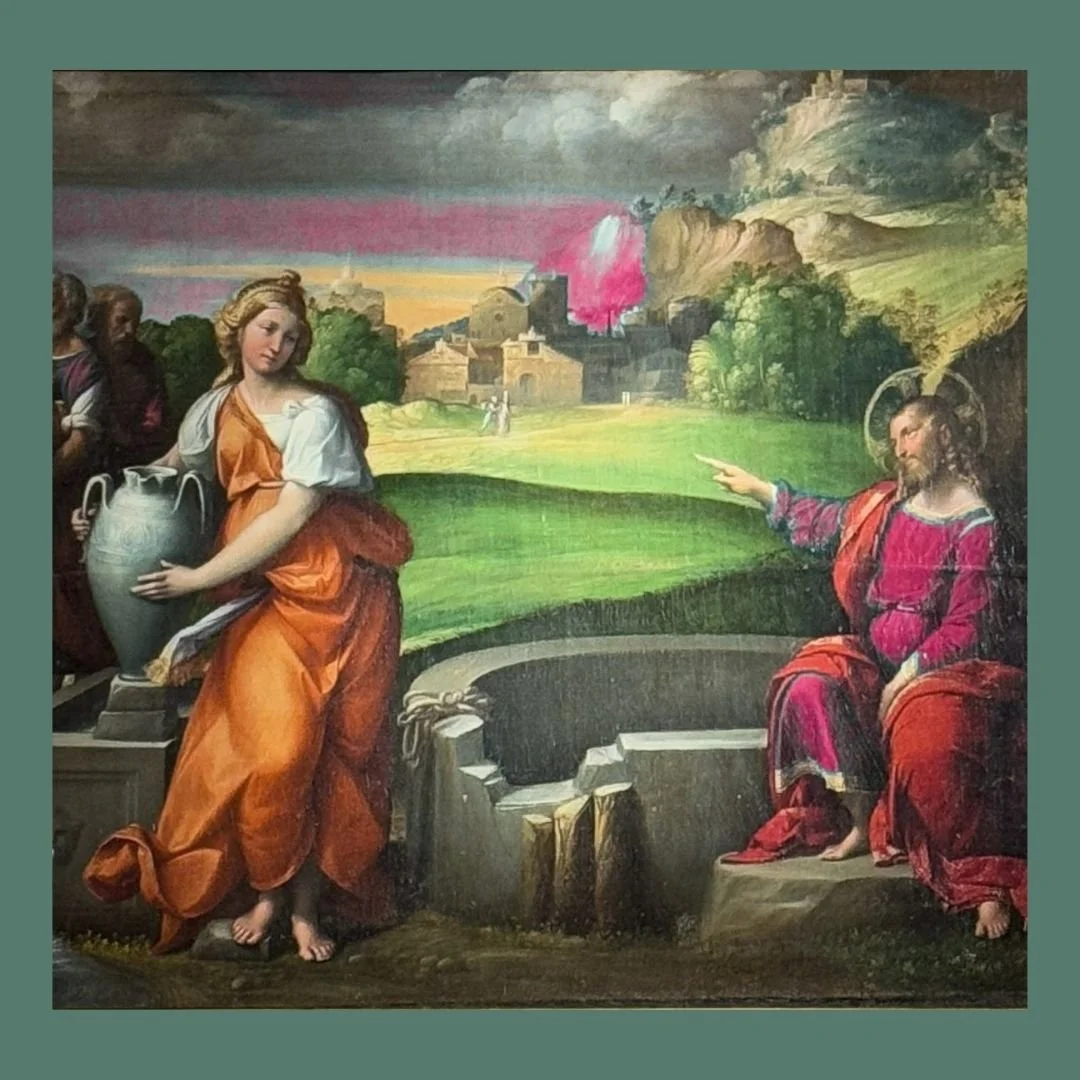
Courtesy of the Visual Museum for Women in Christianity #: 0203
Photographer: Kelly Dippolito
For centuries, the Samaritan woman at the well has been read as a scandal. But if you take a closer look at the text, something shifts. Historical context and scholarship reveal that she was far more likely a survivor than a sinner — and reading her through a Western lens has distorted the story. The real story is far more compelling — and it tells us everything about the heart of Jesus. Because when it was time to reveal who he was, Jesus didn't choose the religious leaders. He chose her. This worn-out, surviving woman at a well became the first evangelist. That's just the kind of God he is. Upside down, like always.
-Christine
Image courtesy of the Visual Museum for Women in Christianity | #: 0203 | Photographer: Kelly Dippolito
The Woman Jesus Saw
WHAT WE’VE BEEN MISSING AT THE WELL
by Dr. Sandra Glahn
Decades ago, I went to a women’s retreat where the speaker told us to pick a Bible story and rewrite it from the point of view (POV) of a character that differed from the one in the story. I chose “the woman at the well” in Samaria (John 4).
But before I get too far into that story, I need to tell readers (or remind them) of the name God gave himself in the story about Moses and the Burning Bush: “I AM.”
Okay, hold that thought.
Now then, the story I chose to retell is the one in which Jesus travels through Samaria on his way to Jerusalem, which is like saying a Jewish person took a shortcut through a pig farm. (In this story, the shortcut shaves off about 30 miles of a 100-mile trip.)
In “unclean” Samaria, Jesus stops at Jacob’s well at noon and meets a woman drawing water. So he asks her for a drink. Jews and Samaritans avoided each other like Trumpies and Never-Trumpers. Plus, men usually avoided speaking publicly with unfamiliar women. So for multiple reasons, Jesus’s request for water stuns this woman.
He quickly reveals that while he is asking her for physical water, he can offer her living water. She takes that to mean she can quit hauling water and asks him for some.
Jesus tells her to go call her husband. She says she has no husband. In response, Jesus reveals details about her life that no charlatan could land on with a lucky guess—she has five husbands, “and the man you have now is not your own.”
What? Can he read minds? Well, yes.
She draws a logical conclusion: he must be a prophet.
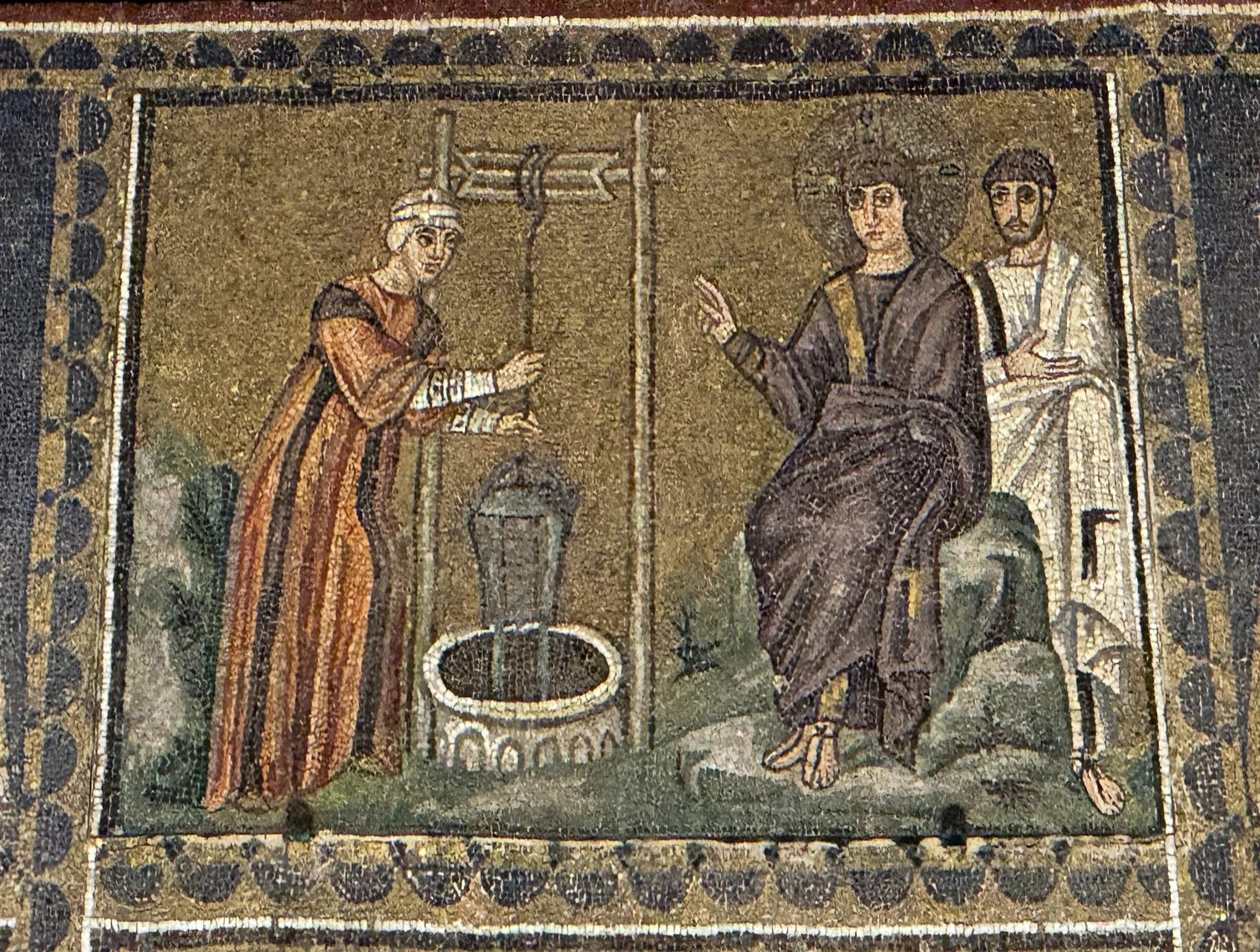
Jesus and the Woman at the Well
Artist: Unknown
Date of Composition: Sixth Century
Exhibit Location: Ravenna, Italy
Courtesy of the Visual Museum for Women in Christianity
#: 0205 | Photographer: Kelly Dippolito
Now, the well where they are holding this conversation has a rich ethnic and spiritual heritage from the patriarch Jacob, grandson of Abraham, whom both parties revere. She wants to know if Jesus is greater than Jacob. And since she has observed that he has the prophetic gift, she asks Jesus to answer the big question at the heart of Jewish/Samaritan relations: Which mountain is the right place to worship—Mount Gerizim or Jerusalem?
Jesus’s answer? Neither. He tells her a time is coming when true worshipers will worship the Father in the Spirit and in truth.
The woman says, perhaps with a sigh, “I know that Messiah—called Christ—is coming. When he comes, he will explain everything to us.” She is waiting for the promised Messiah.
And he comes right out with it: “I AM.”
Jesus never does get a drink. This woman leaves her water jar, hightails it back to her town, tells her people about him, and brings them out to meet Jesus. As they are coming, Jesus tells his now-returned disciples that the harvest is plentiful. And it apparently includes people they generally despise.
That’s the short version of the story I retold from the POV of the town gossip. But I saw my “loose woman” character as a serial adulterer currently with a live-in boyfriend. The takeaway: Jesus can forgive all that.
And he can. He does.
But I had this woman all wrong.
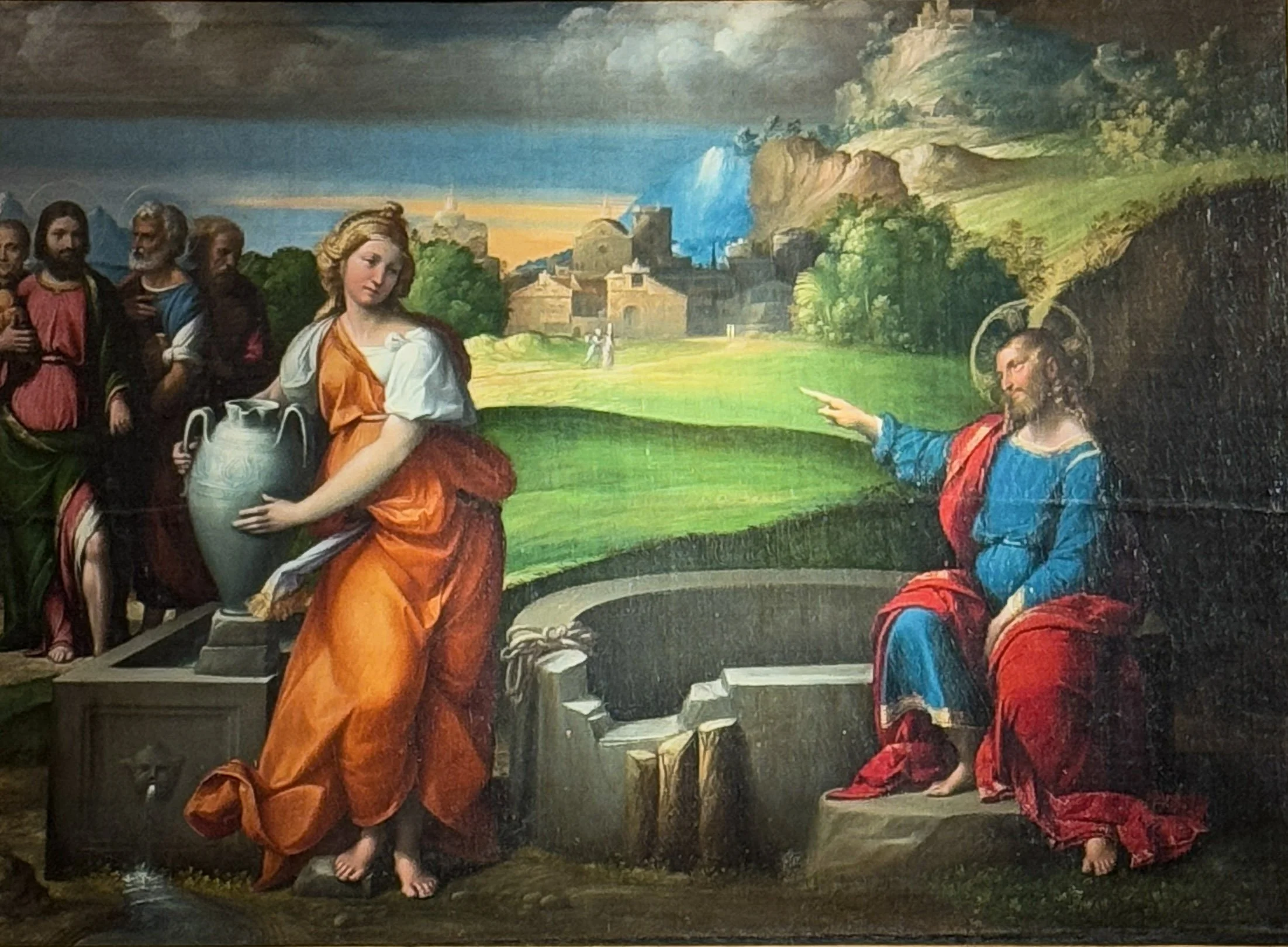
Christ and the Samaritan Woman
Artist: Benvenuto Tisi, called Garofalo (1448-1559)
Date of Composition: c. 1540
Exhibit Location: Rome, Italy
Courtesy of the Visual Museum for Women in Christianity
#: 0203 | Photographer: Kelly Dippolito
My parents raised me to attend a church that spent little time teaching the Bible. But in my teens I began attending a church where I heard a lot more biblical teaching. And I heard this story referenced a lot.
Only years later, long after I graduated from seminary, did I learn that many in church history took a more charitable view of The Samaritan Woman as a good woman waiting for Messiah. Some years after my mother was received into the Antiochian Orthodox Church, she told me that for centuries Christians had called this woman “St. Photini,” (a hidden reference to light or enlightenment).
How to reconcile such differing views?
I’d been taught Photini was at the well alone because she was ostracized for being immoral. Yet the text says nothing about her even being alone.
Second, she’s there “at the sixth hour.” The text makes no connection with the time and her being an outcast. I suspect that detail has more to do with explaining why the disciples are gone (they’re hungry) and to contrast this woman with Nicodemus—who, in the previous chapter, is shown to have skulked around to find and talk to Jesus at night. John the Gospel writer loves to contrast light and darkness. And describes Nicodemus talking to Jesus after dark while this woman converses with Jesus in the light of day. Nicodemus is a religious leader; she’s a nobody.
Women in Jesus’s day didn’t show up in divorce court—any court, really—without male guardians. So how to explain the five husbands? Perhaps she was abandoned multiple times. Or widowed. Probably a combination of these. But whatever the reasons, she has been through some pain. Some serious pain. Yet she still hopes for the day that Messiah will come and explain it all.
I suspect that’s why Jesus took the shortcut. It would be just like him to go through a land off-limits to tell a woman in pain some great news.
But still, what about the man who was “not your own”? A popular gospel hymn, “Fill My Cup, Lord,” begins, “Like the woman at the well I was seeking for things that could not satisfy….” The implication is that she sought sex, love, romance instead of God.
And while John’s language is neutral, many commentators have made assumptions about the woman’s immorality. And hey, no judgment from me—I was among them.
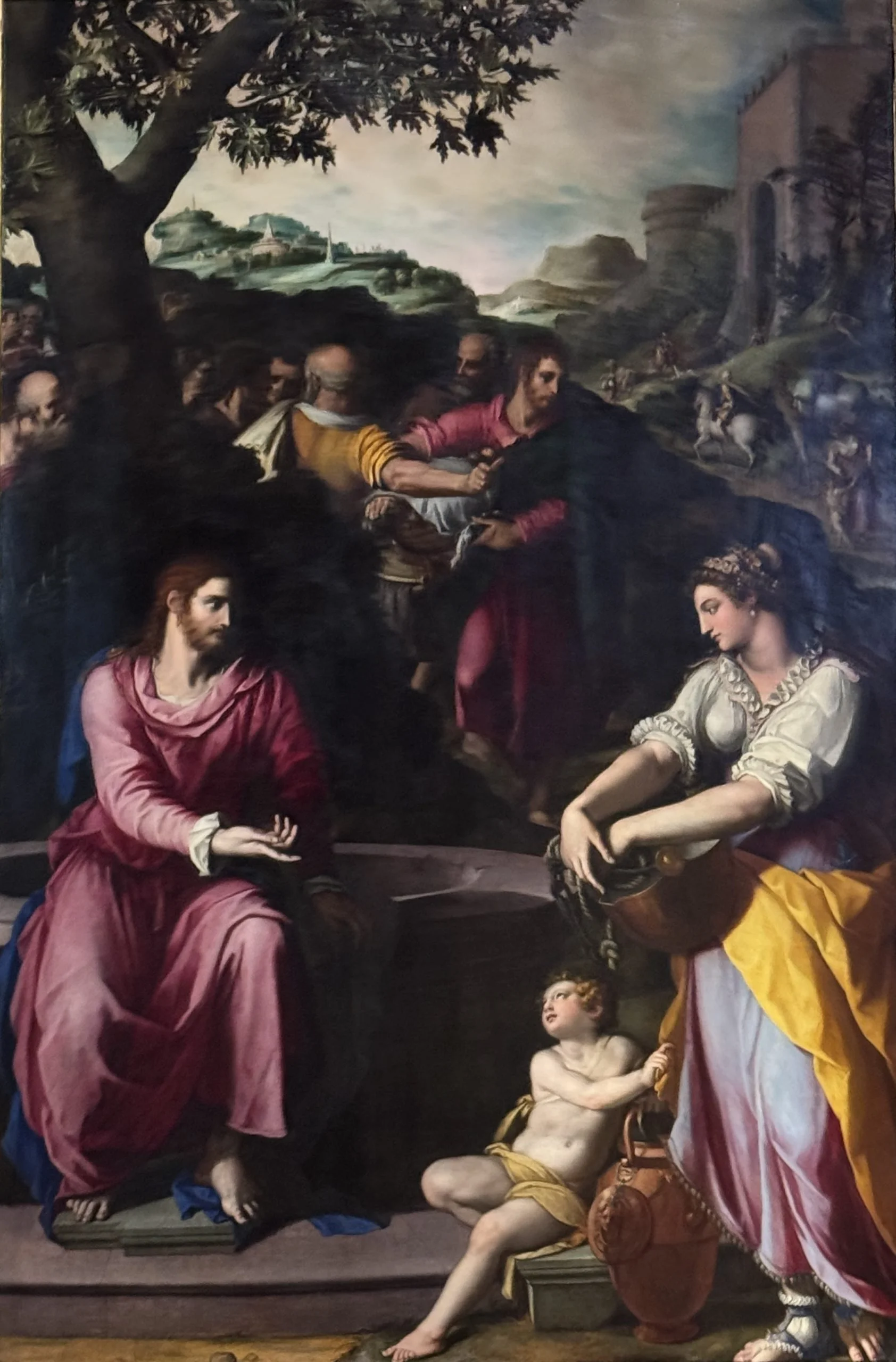
Jesus at the Well with the Samaritan Woman
Artist: Alessandro Allori (1535-1607)
Date of Composition: 1575
Exhibit Location: Florence, Italy
Courtesy of the Visual Museum for Women in Christianity
#: 0206 | Photographer: Kelly Dippolito
But there are several ways a woman could “have” a man or husband (the word is the same in Greek) without “having” him. Her husband could be a polygamist—and a number of other possibilities that cast no shade on this vulnerable woman.
Such a scenario also better fits a context in which it is unlikely that a woman would initiate five divorces. It also fits better a situation in which marriage was more about food on the table than love and romance or choice.
But whatever the reason, truly, this woman has experienced a terrible life. The question is whether readers of the biblical text are supposed to attribute her misery to her own actions.
Seeing her as innocent helps make John’s point of emphasizing Jesus’s knowledge, providing a detail of the woman’s life that he could never have guessed without the benefit of omniscience: five husbands and part of a sixth.
When Jesus goes out of his way to have this conversation, he demonstrates he knows about the five and a half marriages. And he’s saying, “I know you, I see you, I understand your pain. And I know you’ve been waiting for me. I’m here!”
Jesus, who usually goes out of his way to veil his identity (perhaps to keep people from trying to make him their political pawn), comes right out with it: “I AM” (Jn 4:26 NLT).
John wants readers to see who Jesus is. He knows things no person could guess. He goes out of his way to care for the vulnerable. Oh…and he is God in the flesh. The one who also revealed himself to Moses as “I AM.”
Want to learn more about biblical women’s stories? Pre-order Dr. Glahn’s forthcoming book, A Woman’s Place Is in the Story. You can even read an excerpt now.

about the Author
Dr. Sandra Glahn
Dr. Sandra Glahn is an author, journalist, seminary professor, and co-founder of the Visual Museum of Women in Christianity. She writes about art and beauty, story, lit, writing, NT backgrounds, and women, especially women’s history and the visual record of women in the church.
We love to collaborate with creatives. Connect with us to have your work featured by The Holy Shift.