
by Dr. Kelley Mathews
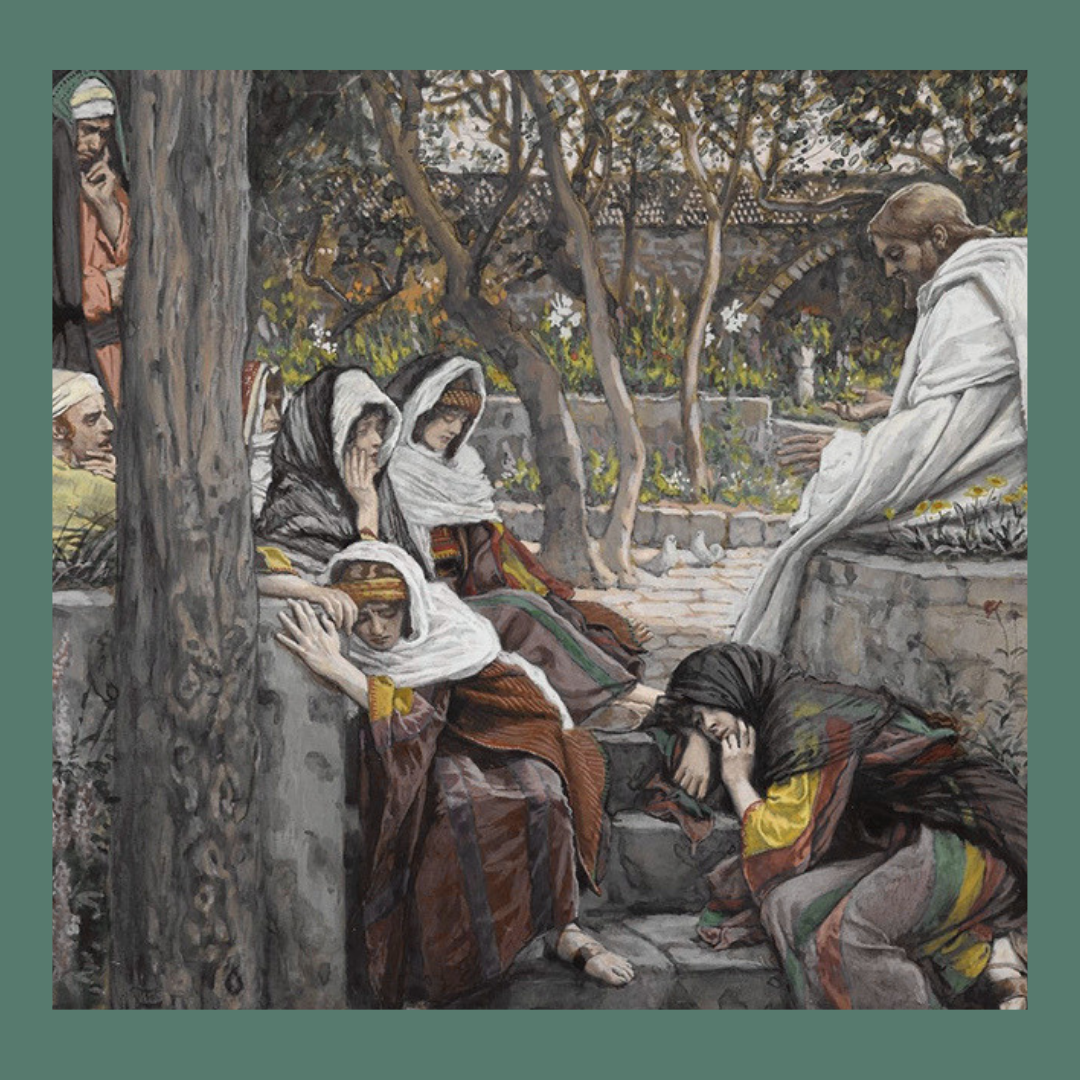
Jesus, Mary Magdalene, and Martha at Bethany (1886-1894)
James Tissot (French, 1836-1902)
One was his mother. One Jesus wept with as she mourned. One was the first messenger of the resurrection.
Three women. All named Mary. All present at the moments that changed everything.
We tend to blur them together, or worse, reduce them to a single supporting role in a story we think belongs to someone else. But Dr. Kelley Mathews, theologian and scholar of women in Scripture and church history, gives each of them back their distinct place in the narrative. Their stories are among the most dramatic of Jesus’s life, death, and resurrection—and definitely worth revisiting.
-Christine
Mourner, Mother, and Messenger
adapted from previously published content in The Estuary with Kelley Mathews
Among tales of triumph, humility, and sacrifice in Scripture, I find myself intrigued by the inclusion of women in three of Jesus’s most significant moments. That each one is named Mary just makes it fun.
Mary the Mourner
Let’s back up to the day Mary of Bethany and her sister, Martha, greeted Jesus in anguish at his “late” arrival, four days after their brother, Lazarus, had died. Both women expressed their faith in Jesus. Martha’s declaration parallels Peter’s in its directness: “I believe you are the Messiah, the Son of God, who comes into the world” (Jn 11:27). Shortly thereafter, Jesus displayed his superpower over death and called Lazarus who, bound in rag-tag cloths, emerged from the grave in need of a shower.
Sometime later, the night before Jesus rode into Jerusalem in his triumphal entry (Palm Sunday), Lazarus and his sisters hosted Jesus and his followers for a dinner. They were all reclining at the table enjoying themselves as Martha served, when things took a turn:
Then Mary took a pound of perfume, pure and expensive nard, anointed Jesus’s feet, and wiped his feet with her hair. So the house was filled with the fragrance of the perfume.
Then one of his disciples, Judas Iscariot (who was about to betray him), said, “Why wasn’t this perfume sold for three hundred denarii and given to the poor?” He didn’t say this because he cared about the poor but because he was a thief. He was in charge of the money-bag and would steal part of what was put in it.
Jesus answered, “Leave her alone; she has kept it for the day of my burial.For you always have the poor with you, but you do not always have me.” John 12:3–8.

John 12
A medieval manuscript showing the story of John 12. Public domain.
I’ve previously written about the progressive nature of the Gospels’ accounts. This scene occurs close to the end of his ministry, as Jesus moves toward Jerusalem to fulfill his mission. When Mary poured out a jar of outrageously expensive perfume on his feet, Jesus recognized her action as an expression of her faith—and understanding. She had been listening. Judas objected with a laughably shallow argument that the money spent on the ointment could have fed the poor, which John as the narrator pinned on his greed. In fact, John narrates the scene in a way that makes Mary a foil to Judas—the faithful disciple versus the unfaithful disciple.
Judas’s objection caused Jesus to speak.
“Leave her alone.”
Holly Carey, in her book Women Who Do, says of the scene, “Jesus defends Mary, connects the ointment with his upcoming burial, and implies that her priorities and sense of urgency are well placed…”
Mary of Bethany gets as close or closer to understanding Jesus’s identity as any of the Twelve. Whatever teaching she heard, conversations she had, or meditations on Scripture she sought, her spirit was homed in on Jesus. She believed him when he had said he was going to die. Women, as we see in Luke 24:1, often did the work of preparing dead bodies with spices and ointment before burial.
Her act of devotion was an act of faith.
Mary his Mother
The Gospel of John includes Jesus's mother in only two places: the wedding in Cana, when Jesus first went public with his ministry, and the cross, where he fulfilled his ministry. The other Gospels tell us that she remained close to Jesus, appearing at various times during his travels. But it is here at the cross that Mary, though she does not speak in the narrative, demonstrates her faithfulness to her son.
Standing by the cross of Jesus were his mother, his mother’s sister, Mary the wife of Clopas, and Mary Magdalene.When Jesus saw his mother and the disciple he loved standing there, he said to his mother, “Woman, here is your son.” Then he said to the disciple, “Here is your mother.” And from that hour the disciple took her into his home. John 19:25–28.
Again Holly Carey writes, “His hour has finally come, and they are there to witness it. Along with the anonymous ‘beloved disciple,’ they are the only disciples mentioned as being present at the foot of the cross. . . . These women represent Jesus’s remaining support—they are the last familiar faces he will see before he breathes his last. They are committed to remaining with him until the end.”
I’ve argued elsewhere that Mary was her Son’s first disciple. She is also one of the most exemplary disciples for us, women and men. First, consider her very presence. She braved the violence, the potential harshness from the Romans, and the shame of the situation. She wasn’t just a grieving mother—she could have wept at home. No, she was a grieving mother and faithful follower, a potent combination that propelled her to Calvary to keep watch as her boy died.
Second, she was living out the prophecy from Simeon (Luke 2:35), a warning that a sword would pierce her own soul. She stood close enough to the cross to hear his labored words. And he spoke to her! Some of his final words were offered in care of her mother.
In giving her to the beloved disciple as a mother, and him to her as a son, Jesus placed her squarely within the apostolic family. And we know from Acts 2 that Mary was with the disciples after Jesus ascended. She and the other women (Acts 2:14) were “continually united in prayer” with the remaining eleven apostles and Jesus’s brothers. The number of followers grew to 120 by the day of Pentecost, when the Spirit descended on each of them. Artists from some of the earliest centuries portray that day with twelve apostles looking up at the tongues of fire, Mary smack in the middle of them all.
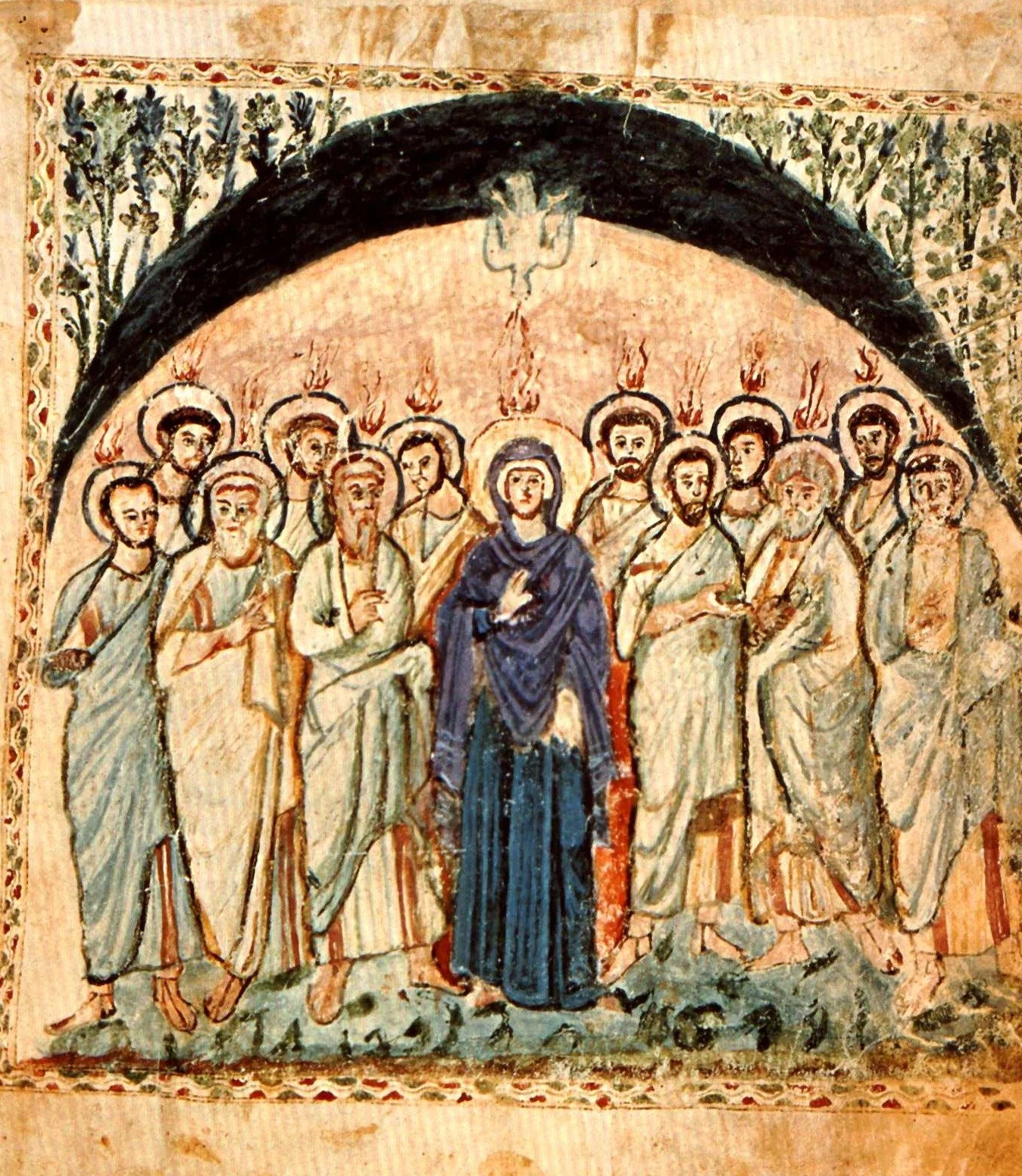
Pentecost
Folio 14v of the Rabbula Gospels, ca 586, 34 x 27 cm, Biblioteca Mediceo Laurenziana, Florence. Public domain.
Mary and the body of Christ are inextricably linked: she was present at the birth of Christ, at his death, and at the birth of his church.
Mary the Messenger
It’s been joked that if churches want to be biblical on Easter, they need to let the women preach.
Mary Magdalene had been with Jesus for a long time. We first meet her and the other women in Luke 8:1–3 where we learn that Jesus had healed her of seven demons. She and the others traveled with Jesus’s crew, supporting them financially and materially. Mary M was also with mother Mary at the cross. She watched where the men laid the body of Jesus. And she and some of the women returned to the grave on the morning of the third day, presumably to finish packing the body with spices per their custom.
But they found an empty tomb. Luke 24 tells the story of how angels told them that Jesus had risen. They ran to tell the Eleven, “but they did not believe the women, because their words seemed to them like nonsense” (v 11). I can’t imagine the frustration she must have felt at their response. But Mary returned to the tomb, and there she met the risen savior
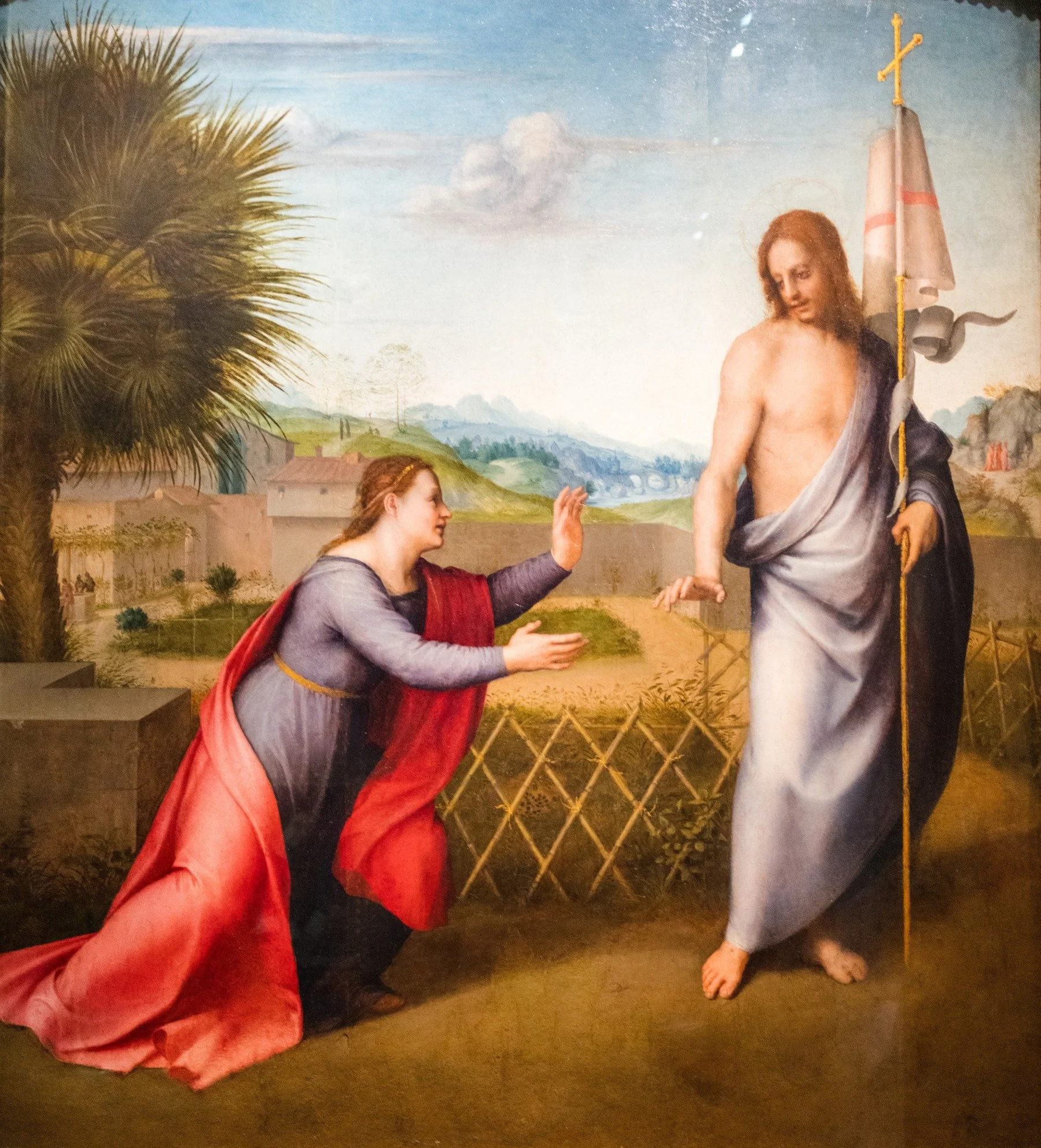
“Noli me tangeri”—Do not cling to me
Giotto, Scrovegni Chapel. 📸 K Mathews
A few things make Mary M’s experience significant.
First, Mary M was a witness: Jesus chose to appear to her first. In a sign of his upside-down kingdom, he revealed himself alive once more, in his glorified body, Christus Victor, having defeated the powers of sin and death… to someone disqualified in her society from giving legal testimony. He chose a woman to witness his resurrection first.
Second, Jesus sent her to proclaim the news. In John 20, she thinks he’s the gardener until he says her name, and then she exclaims, “Rabboni!” He tells her not to cling to him, as in “hold too tightly. “But go to my brothers and tell them that I am ascending to my Father and your Father, to my God and your God” (v 17).
A sent one is an apostle. It’s what the word apostello means. Jesus sent her to proclaim THE Good News. Some English Bible versions smooth over the word used for what Jesus sent her to do: tell or preach or proclaim? All three options have been used to translate the Greek apongello. I’ll quote my friend Sarah Griffith here:
“For example, Mary, “Told all these things to the eleven and others” (Luke 24:9), but Paul, “Preached that they should repent” (Acts 26:20). The word “told” and the word “preached”? Same. Exact. Greek. Word. Same public declaration to a group.”
Mary apongelloed the euangelion: She told/proclaimed/preached the good news.
Finally, a thought gleaned from The Mary We Forgot, by Jennifer Powell McNutt: Remember that the moment Jesus died, the curtain in the temple that hid the ark of the covenant, symbolizing God’s presence, split in two from top to bottom (Luke 23:45). The Holy of Holies was now exposed, that sacred place only entered once per year on the Day of Atonement. Jesus’s death was the final atonement, and he is our high priest readily available for us to approach. When Mary witnessed him in the now-glorified flesh, having risen from death to life, her life was transformed. She was given an apostolic calling. McNutt quotes Craig Keener here: “Perhaps the old veil was ‘rent’ because the new order would not fit it.”
We are all invited near to Jesus. And the “disqualified” are now the called ones.
The resurrection changes everything—spiritually, physically, socially. The kingdom of God has come, and Mary was chosen to take that amazing news from the garden to the world.
Three Marys: one preparing him for death, two offering their presence at his death, one witnessing his victory over death. Each one confident in her savior, each one acting on her faith, each one a witness to his glory.
Be a Mary.
“Perhaps it is no wonder that the women were first at the Cradle and last at the Cross. They had never known a man like this Man—there never has been such another.” Dorothy Sayers, Are Women Human

about the Author
Dr. Kelley Mathews
Kelley Mathews (DMin, Houston Christian University; ThM, Dallas Theological Seminary) is a multi-published author, editor, and Bible teacher. Her dissertation research traces the development of Marian theology and explores the life of Mary, mother of God, as a model of discipleship.
Kelley has over twenty-five years’ experience in the Christian publishing and nonprofit domains. She has served as a Publishers Weekly fiction reviewer, Christy Award judge, and Christianity Today Book Award judge.
Find Kelley talking about all things Bible on various podcasts. A grammar enthusiast, Bible nerd, and “human highlighter” eager to promote other authors, she writes regularly at her Substack and through a variety of publishing and speaking projects.
We love to collaborate with creatives. Connect with us to have your work featured by The Holy Shift.