
Blackness as a Love Language
by Chanté Griffin
Blackness as a Love Language
An excerpt from the Introduction of Loving Your Black Neighbor as Yourself: A Guide to Closing the Space Between Us (WaterBrook/Penguin Random House).
Blackness is my mother tongue, my very first love language.
I was birthed in a Black Pentecostal church. My dark-skinned body was birthed into choir rocks and hand claps, my spirit reborn in the cool baptismal pool. My speech refined with new tongues, and my future prophesied into being.
I don’t remember my parents (barely adults themselves) keeping my little sister and me on any precious sleeping schedule: 6:00 dinner, 7:00 bath, 8:00 bedtime story. I do remember falling asleep at church to the sound of the drummer’s snare and the organ’s sirens. I remember women shouting and wailing and being ensconced by other women in white who fanned them as they lay outstretched on the floor, discreetly covered by white sheets.
My sis and me were “church babies”—children whose sleep can withstand the preacher’s whoops and the congregation’s hollers, permanent fixtures at most Black Pentecostal churches. We usually passed out on the pews, clutching our children’s Bibles to keep Satan from prying them from us. Sometimes we wore bows in our hair and lace on our socks, accented by the black patent leather shoes our mothers bought us for Easter service. Sometimes we sported little wool jackets and bow ties that matched our fathers’. We’d been taught we must always look good for God.
I remember children’s church, where I learned that “Jesus loves the little children, all the children of the world: Red and yellow, black and white, they are precious in His sight.” I remember Sunday night service, Thursday night Bible study, and Saturday morning choir rehearsal.
For the first ten years of my life, my world was completely Black. I attended an all-Black church in South Central Los Angeles and that church’s all-Black private Christian school, and my family lived in an adjacent all-Black neighborhood. I remember only one exception to this all-Black world: Cindy, the only non-Black person in our entire K–8 school. Cindy was Filipina, wore a short bob with bangs, and always had a lot of money. And when I say “a lot of money,” I mean five dollars.
I knew about other racial groups, but I never interacted with them. My experience was not uncommon for a young Black girl living in South Central Los Angeles in the 1980s.
The Black world was the only one I knew. And it felt safe, even with the helicopters that sometimes flew above my neighborhood as I played double Dutch with my friends on the cracked concrete pavement. To us, Blackness was as natural and unassuming as the daily sunrise. It’s amazing how much self-esteem we built as the standard and not the deviant.
I didn’t know to cherish these moments. I didn’t know that my world would turn upside down when my parents decided we were “movin’ on up”2 to a neighborhood in the San Fernando Valley, where my sister and I would become two of four Black kids in an entire elementary school. There, I learned that the outside world didn’t just not see us. It didn’t love us.
about the Author
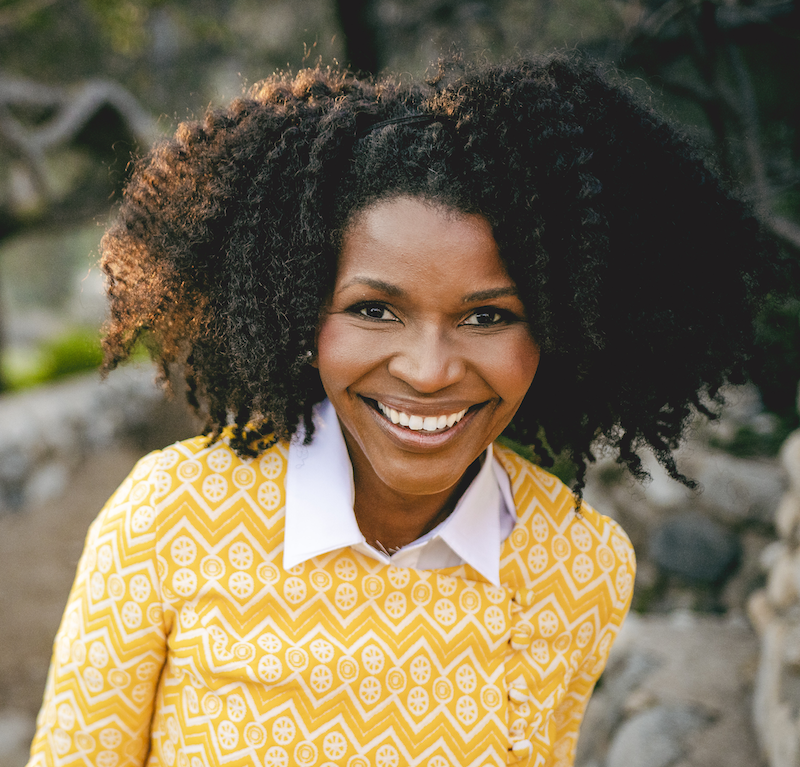
Chanté Griffin
Chanté Griffin is a literary artist (journalist + author) and performing artist (actor + TV personality) who uses the arts and media to advocate for equity and wellness for all — particularly Black Americans. Her work centers on the intersection of racial equity and spiritual and communal wellness.
She is the author of Loving Your Black Neighbor as Yourself: A Guide to Closing the Space Between Us (WaterBrook/Penguin Random House). Contributing writer for The Washington Post, Faithfully Magazine, and LA Parent Magazine. Her work has appeared in EBONY, The Huffington Post, The Los Angeles Times, Good Housekeeping, Marie Claire, and more.
Chanté also coaches creatives through Spirit & Scribe, an online workshop at the intersection of writing craft and spiritual formation.
We love to collaborate with creatives. Connect with us to have your work featured by The Holy Shift.